
Discord announced on October 27, 2026 that public community content is heading into search engines. The headlines have been broad enough to worry a lot of people who do not need to worry, so here is the actual scope, the two dates that matter, and the settings that switch the feature off.
Short version: a narrow slice of Discord becomes searchable, nothing you have already posted is affected, and opting out takes about thirty seconds.
What Is Actually Happening
The rollout arrives in two stages.
November 16, 2026. Every Discoverable server gets a public web page. Those pages preview what a community contains before somebody joins, include automated channel summaries, and can be crawled and indexed by Google.
Mid-December 2026. Individual messages from public channels in those servers begin appearing, rolling out gradually rather than switching on everywhere at once. Usernames and avatars stay hidden, and messages surface as text.
Who This Covers, and Who This Does Not
The eligibility bar is the part most coverage has skipped, and the bar is high. A server qualifies only by being Discoverable, meaning anyone can find and join without an invite, and having at least 1,000 members, and being at least eight weeks old, and meeting Discord's activity and safety requirements. Discord has put the current number of qualifying servers at roughly 63,000, which is a thin slice of the platform.
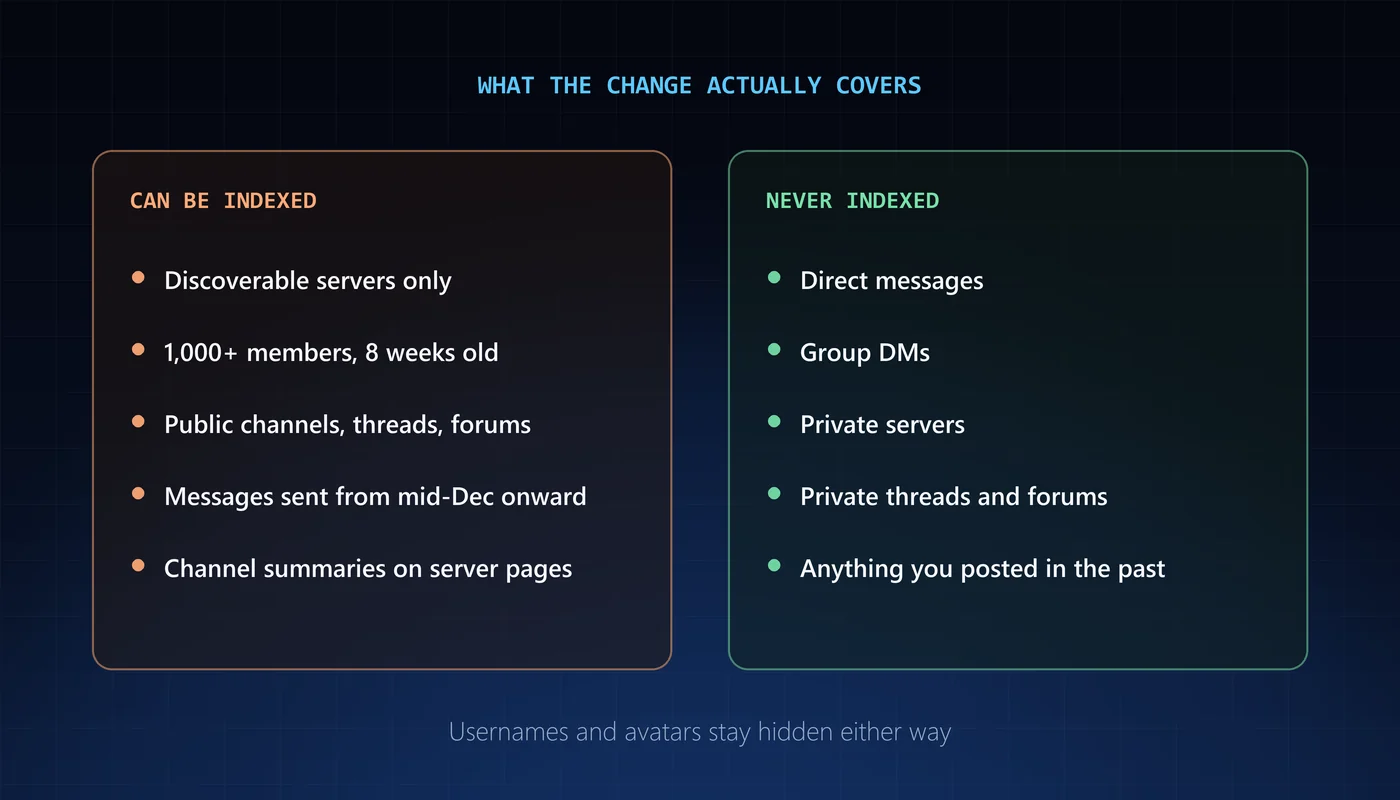
Two exclusions deserve calling out directly, because both get lost in the noise:
- Direct messages and group DMs are never included. Neither are private servers, private threads or private forums.
- Nothing you posted in the past gets published. Only eligible messages sent from the mid-December rollout onward can appear. Your history from last year is not about to land in search results because of this change.
How to Opt Out
There are two separate controls, and knowing which one applies to you saves a lot of hunting.
If you are a member
- Open User Settings in Discord.
- Go to Data & Privacy.
- Turn off the option to show your message content from Discoverable channels on web pages.
That switch is account-wide. Flipping the switch once covers every Discoverable server you belong to, now and in future.
If you run a server
- Open Server Settings.
- Go to Web Presence.
- Exclude individual channels, or switch off message publication for the whole server.
Worth knowing: a member opting out does not disable the automated channel summaries, which sit under the admin controls instead. If you run a community and want nothing published, the server-side setting is the one to use.
Check your defaults rather than assuming
The member-level setting is reported as on by default in most regions and off by default in the EU and EEA, the UK, Canada, Brazil, Australia and South Korea. Teen accounts are excluded entirely. Regional behaviour during a staged rollout is exactly the sort of detail that shifts, so open the setting and look rather than trusting a summary, including this one.
Worried about what search engines can see of your business?
The same question applies to your own site, your old pages and anything you have published under your brand. We audit that and fix what should not be public.
Why We Built a Discord Cleanup Tool
We maintain an open-source tool called DiscordCleanupTool, which bulk-deletes your own Discord messages across DMs, group DMs and server channels.
Being straight about the timing: this news is not the reason to reach for that tool. Past messages are not being indexed, so deleting an old archive does nothing about the change described above. The opt-out setting is the correct and sufficient response there, and the setting is free and instant.
The tool solves a different problem. Plenty of people want their own trail cleaned up for ordinary reasons: a years-old account tied to a name they no longer use, messages in a community they have left, or simple housekeeping on a platform that offers no bulk delete of your own history. Discord gives you no supported way to do that at scale, which is the gap the tool fills.
What the tool does:
- Deletes only your own messages, filtered against your user ID, so other people's posts are never touched.
- Works across DMs, group DMs and server text channels, picked individually.
- Dry run by default, so you see what would be removed before anything is.
- Paces itself under Discord's rate limits, with header-driven backoff and retry on 429s.
- Runs locally on
127.0.0.1with a browser dashboard or a CLI. Your token stays in memory and is never written to disk. - Filters by text, date range and count, with a stop control mid-run.
- No dependencies, no build step, MIT licensed.
Read this before you use any Discord cleanup tool, ours included
Driving your account with a user token breaks Discord's Terms of Service. Discord provides no supported route for bulk deleting your own messages, and accounts have been terminated for automating user tokens. That risk is real and the choice is yours to make with open eyes.
Deletion is permanent. There is no undo, no trash and no export step. In a DM, removal also deletes the message from the other person's client.
Treat your token like a password. A user token grants full account access with no password or 2FA prompt. Never paste one into a website or a script you have not read. Ours runs on your own machine and the source is public precisely so you can check that claim.
Bot tokens are supported and carry none of that risk, with one limitation worth understanding: a bot can only delete messages the bot itself sent, so bot mode cannot clean your personal DMs.
What We Would Actually Do
In order, for most people:
- Open the member setting and decide deliberately whether to leave the setting on. Thirty seconds, no risk, and the setting covers the change in this announcement completely.
- If you run a Discoverable community, review Web Presence and exclude any channel where people speak more freely than they would on a public web page.
- Tell your members the change is happening. A community that finds out from a Google result rather than from you is a community with a trust problem.
- Separately, and for separate reasons, decide whether you want your historical footprint cleaned up at all. If the answer is yes, weigh the Terms of Service risk honestly first.
The broader point lands well beyond Discord. Platforms change what public means, usually with notice and usually in the direction of more visibility. Assuming anything posted in a public channel could one day be searchable is the posture that ages well.
Need an audit of what the web can see?
Old pages, stale listings, indexed staging sites, content you forgot was live. We find what is exposed under your brand and clean up what should not be.
Details here reflect reporting as of October 28, 2026, the day after Discord's announcement. Staged rollouts change, particularly regional defaults and exact dates. Confirm against Discord's own settings and announcement before acting on anything time-sensitive.
Frequently Asked Questions
Some of them are about to be. Discord publishes a web page for every Discoverable server from November 16, 2026, and those pages can be indexed by Google. Individual messages from public channels in those servers begin appearing from mid-December 2026 in a gradual rollout. Direct messages, group DMs and private servers are not included at any stage.
The rollout runs in two stages. Server web pages and automated channel summaries go live on November 16, 2026. Individual message indexing starts in mid-December 2026 and rolls out gradually rather than all at once. Discord announced both stages on October 27, 2026, and the dates could still move.
Open User Settings, go to Data & Privacy, and turn off the option to show your message content from Discoverable channels on web pages. That switch is account-wide and covers every Discoverable server you belong to. Server admins use a separate control at Server Settings then Web Presence, which can exclude individual channels or switch off message publication for the whole server.
No. Direct messages and group DMs are excluded from this feature entirely, as are private servers, private threads and private forums. Only public channels inside Discoverable servers are in scope, and a Discoverable server has to have at least 1,000 members and be eight weeks old before qualifying.
No. Only eligible messages sent from the mid-December rollout onward can be published. Discord has said older message history will not be surfaced through this feature, so the archive of what you posted last year is not about to appear on Google because of this change.
Only Discoverable servers, meaning communities anyone can find and join without an invite. A server must have at least 1,000 members, be at least eight weeks old, and meet Discord's activity and safety requirements. Discord has said roughly 63,000 servers currently meet the bar, which is a small fraction of the platform.
The user-level setting is on by default in most regions. Reporting indicates the setting is off by default in the EU and EEA, the UK, Canada, Brazil, Australia and South Korea, and that teen accounts are excluded and cannot switch the setting on. Check your own settings rather than relying on where you live, since regional details can change during a rollout.
Discord offers no built-in bulk delete for your own message history, so clearing an archive means removing messages one at a time or using a third-party tool. Be aware that tools driving your account with a user token breach Discord's Terms of Service and can get the account terminated, and that deletion is permanent with no undo. For this particular change the opt-out setting is the safer and more relevant control, because past messages are not indexed anyway.